 By Ali Demirci, founder of Woofocus · October 21, 2026 · 5 min read
The short answer
For most everyday work in a studio, such as writing, planning and routine code, use Sonnet 5.5. Move to Opus 5.5 for the hard ones: a large refactor, a bug nobody can find, a long agent run. Use Haiku 5.5 for many small, quick jobs such as sorting, tagging and routing. Fable 5.1 is for the longest and hardest work when Opus falls short, and on most plans it costs extra.
Anthropic itself gives two starting points. Its models overview says: "If you're unsure which model to use, start with Claude Opus 5.5 for most workloads." Its Claude Code help says: "Sonnet is the right choice for the large majority of coding work." Both hold in their own setting. On a plan with usage limits, Sonnet saves your quota. On the API, where you pay per token, Opus is the safer place to start testing.
- $2 / $10Sonnet 5.5, per million tokens in and out
- $4 / $20Opus 5.5
- $0.10 / $0.50Haiku 5.5, for prompts up to 100,000 tokens
- $10 / $50Fable 5.1
The four models side by side
| Model | Anthropic's description | Speed | API price per million tokens, in / out |
|---|---|---|---|
| Fable 5.1 | For demanding reasoning and long-horizon agentic work | Slower | $10 / $50 |
| Opus 5.5 | For long-running agentic coding and knowledge work | Moderate | $4 / $20 |
| Sonnet 5.5 | The best combination of speed and intelligence | Fast | $2 / $10 |
| Haiku 5.5 | For high-volume, latency-sensitive tasks such as classification, extraction, and routing | Fastest | $0.10 / $0.50 for prompts up to 100,000 tokens |
All four read up to 1 million tokens, write up to 128,000 in one answer, and came out between 1 September and 7 October 2026. Requests sent in a batch cost half.
Sonnet or Opus
Opus costs twice as much per token as Sonnet and answers more slowly. In Claude Code, where usage counts against your plan, Anthropic's help is blunter: "Opus costs several times more per turn than Sonnet, and Sonnet more than Haiku," and Opus "uses meaningfully more of your quota, so consider switching to Sonnet for routine work." It keeps Opus for "large cross-cutting refactors" and "difficult debugging, or architectural decisions".
For an agency that means Sonnet for the daily build and fix work, and Opus when a developer is stuck or a change touches the whole site. Claude Code's opusplan setting does both: it "uses opus during plan mode, then switches to sonnet for execution". Claude Code starts on Opus 5.5 on Pro, Max, Team and Enterprise, so if most of your work is routine, /model sonnet is worth a try.
What our own app uses
We build Proofyard on Claude, so we read our own code for this guide. It uses two models, set in one place: one for "quick answers (drafting a line, triage, reading a rule)" and one for "longer thinking (a plan, a check)", as the comment above them says.
- Sonnet 5.5 does the work a person asks for and waits on: turning a brief of up to 30,000 characters into a plan, reading meeting notes and documents, reading a client's site (up to 25 pages), drafting a scope or a change order, the Claude panel that can look things up and propose changes, and the daily read that suggests what to remember.
- A Haiku model does the many small jobs that run by themselves: suggesting who, when and how urgent while someone types a task, the next step after a comment, sorting a new feedback note, reading the text in a screenshot, checking a new task against the signed scope, and answering a client's question in their own area. Most of these answers are a few hundred tokens long. The full list is on our smart actions page.
- Nothing calls Opus or Fable. Every job is short and bounded, and a person checks the result.
- If a call fails, the app falls back to a plain rule or says so, so the board never waits on the model.
One honest detail: the quick tier still calls Haiku 4.5. We set it on 7 October 2026, the day Haiku 5.5 came out, and have not switched yet. Anthropic lists Haiku 5.5 at $0.10 and $0.50 per million tokens against $1 and $5 for Haiku 4.5. Newer models count about 30% more tokens for the same text, and Haiku 5.5 still works out far cheaper per call. If you are building something similar today, start the quick tier on Haiku 5.5.
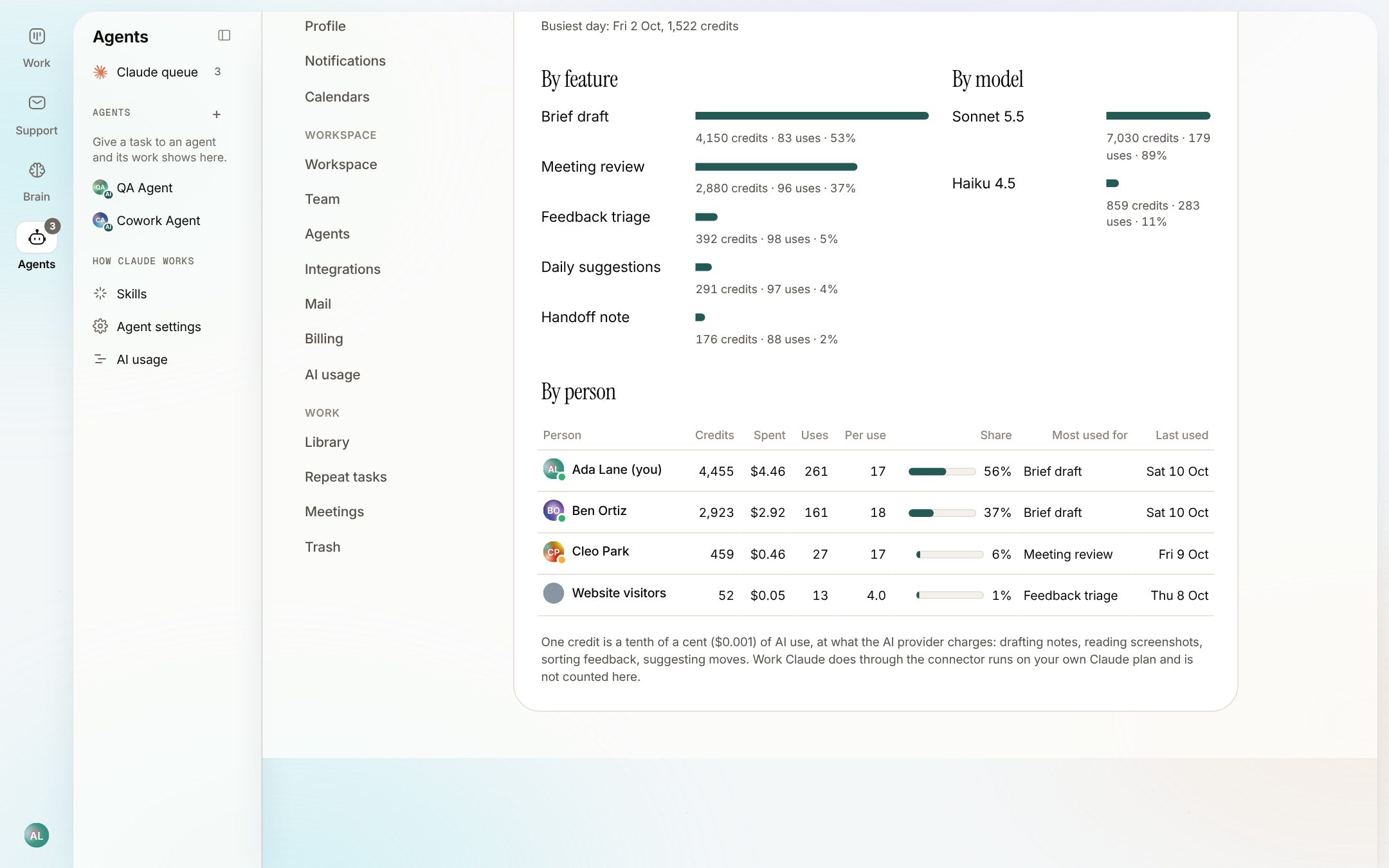
Work Claude does for you through our connector, in claude.ai, Claude Code or Cowork, runs on your own Claude plan, so it uses whichever model you picked there.
Which model for which job
Pick the job, and see which model we would start with:
What is the job?
Use Sonnet 5.5
Everyday writing. Anthropic lists content creation under Sonnet.
- Setup
- The default effort
- Claude sees
- The brief, your notes and the client's earlier mail
Raise the effort before you pay for a bigger model
Anthropic's guide to choosing a model puts it plainly: "Tuning effort is often a better lever than switching models." Effort runs from low through medium, high and xhigh to max. On the API, Sonnet 5.5 and Fable 5.1 start at high, and Opus 5.5 and Haiku 5.5 at medium. Its advice is to move from Opus 5.5 to Fable 5.1 only "if your evals at xhigh or max effort still fall short".
A bigger model also does not fix missing context. In our experience the brief, the client's earlier decisions and the files matter more than the model; that is why our board gives Claude the project before it answers.
Before you move to a bigger model
0 of 5
Stay where you are for now and work through the list first.
Which models your plan includes
| Plan | Sonnet and Haiku | Opus | Fable | Claude Code |
|---|---|---|---|---|
| Free | Yes | No | No | No |
| Pro | Yes | Yes | On usage credits | Yes |
| Max | Yes | Yes | Up to 50% of weekly limits | Yes |
| Team, Standard seat | Yes | Yes | On usage credits | Yes |
| Team, Premium seat | Yes | Yes | Up to 50% of weekly limits | Yes |
| Enterprise | Yes | Yes | Yes | Yes |
From Anthropic's pricing page and its support article on Fable models. What a team pays for each seat is in our guide to Claude for small business.
Older models you may still be using
- Sonnet 4.5 is deprecated and retires on 30 November 2026. Anthropic's replacement is Sonnet 5.5.
- Haiku 4.5 leaves the model menu in claude.ai on 29 October 2026 on Free, Pro and Max, and Haiku 5.5 replaces it. It stays in Claude Code, on Team and Enterprise and in the API.
- Comparing prices across generations: since Claude 4.7, the same text makes "approximately 30% more tokens". Compare what a finished task costs, not the price per token.
- Anthropic promises at least 60 days' notice before it retires a public model.
Sources
Everything about the models is from Anthropic's own pages, read on 21 October 2026.
- Models overview
- Choosing a model
- Pricing
- Model deprecations
- Models, usage and limits in Claude Code
- Claude Code model configuration
- Claude Haiku 4.5 is leaving the model selector
- Claude plans and pricing and Fable models on your plan, 2 September 2026
- How Proofyard uses Claude: our code as of 21 October 2026. The screenshot is from the app's preview with sample data; the people in it are made up.