Feature
A knowledge base your team and Claude both read
Studio pages, project pages, memories with where each came from, and a Project card per client. Claude reads them before it works, and people decide what is kept.
Brain
Write it down once, and stop explaining it in every brief
Every studio has things everyone is supposed to know: what a care plan includes, that one client approves copy by email, that another writes in British English. Most of it lives in someone's head or in an old thread, and Claude only knows it if someone pastes it in again.
Brain is where the board keeps it. Knowledge holds pages people write, for the studio and for each project. Memory holds short rules and decisions, each with where it came from. Each project also gets a Project card, a Growth page and a Strategies page. Claude reads all of it before it works on a project, and nothing it suggests is kept until a person keeps it.
- 01
Pages for the studio and for each project
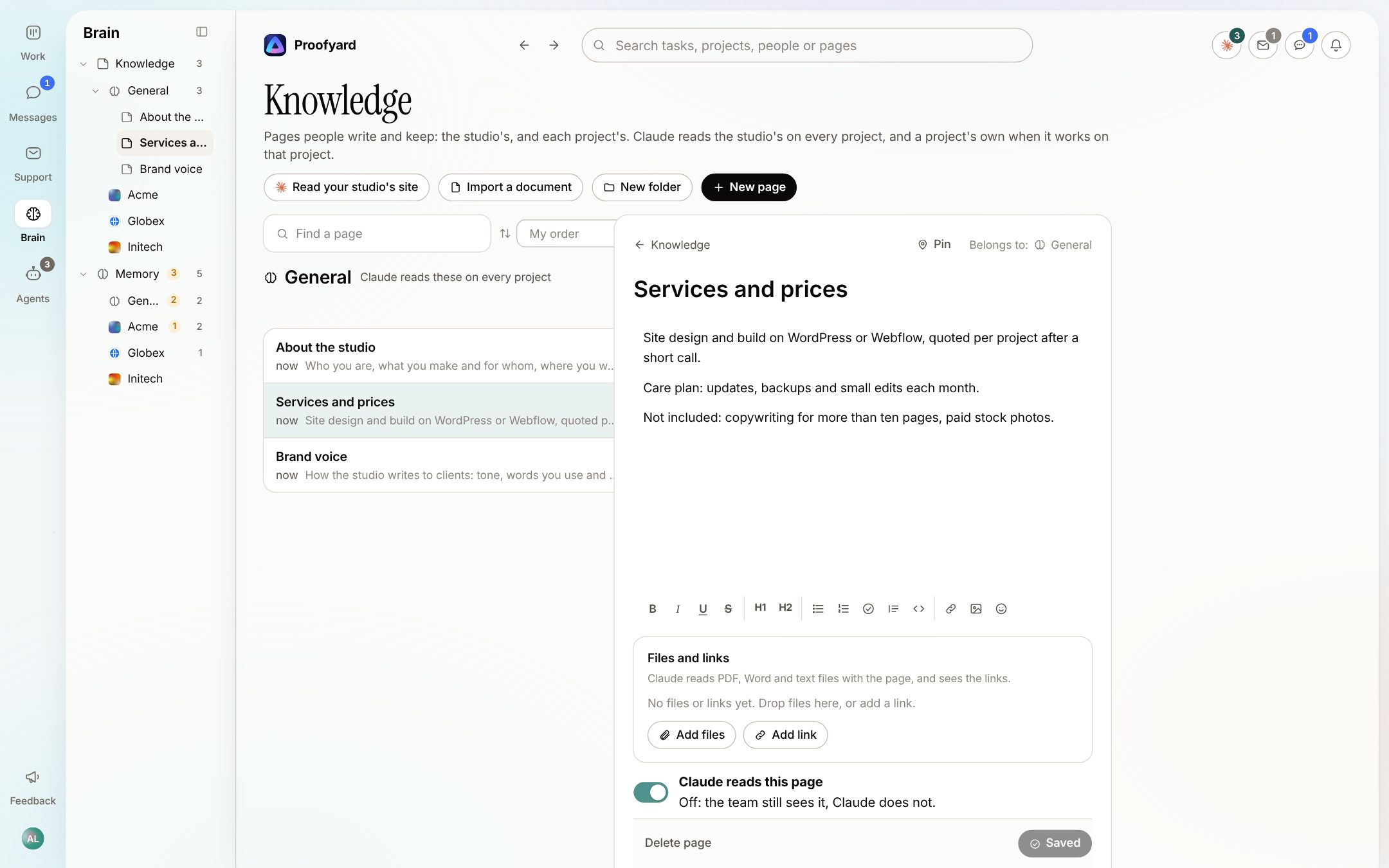
Knowledge starts with three pages if you want them: About the studio, Services and prices and Brand voice. General holds the studio's pages, which Claude reads on every project; a project's own pages, like a brand guide, are read only on that project and seen only by its team. Pages sit in folders, the tree panel shows them all, and Find a page searches them. Add files and links under a page: Claude reads PDF, Word and text files with it.
- 02
Memory, with where each memory came from
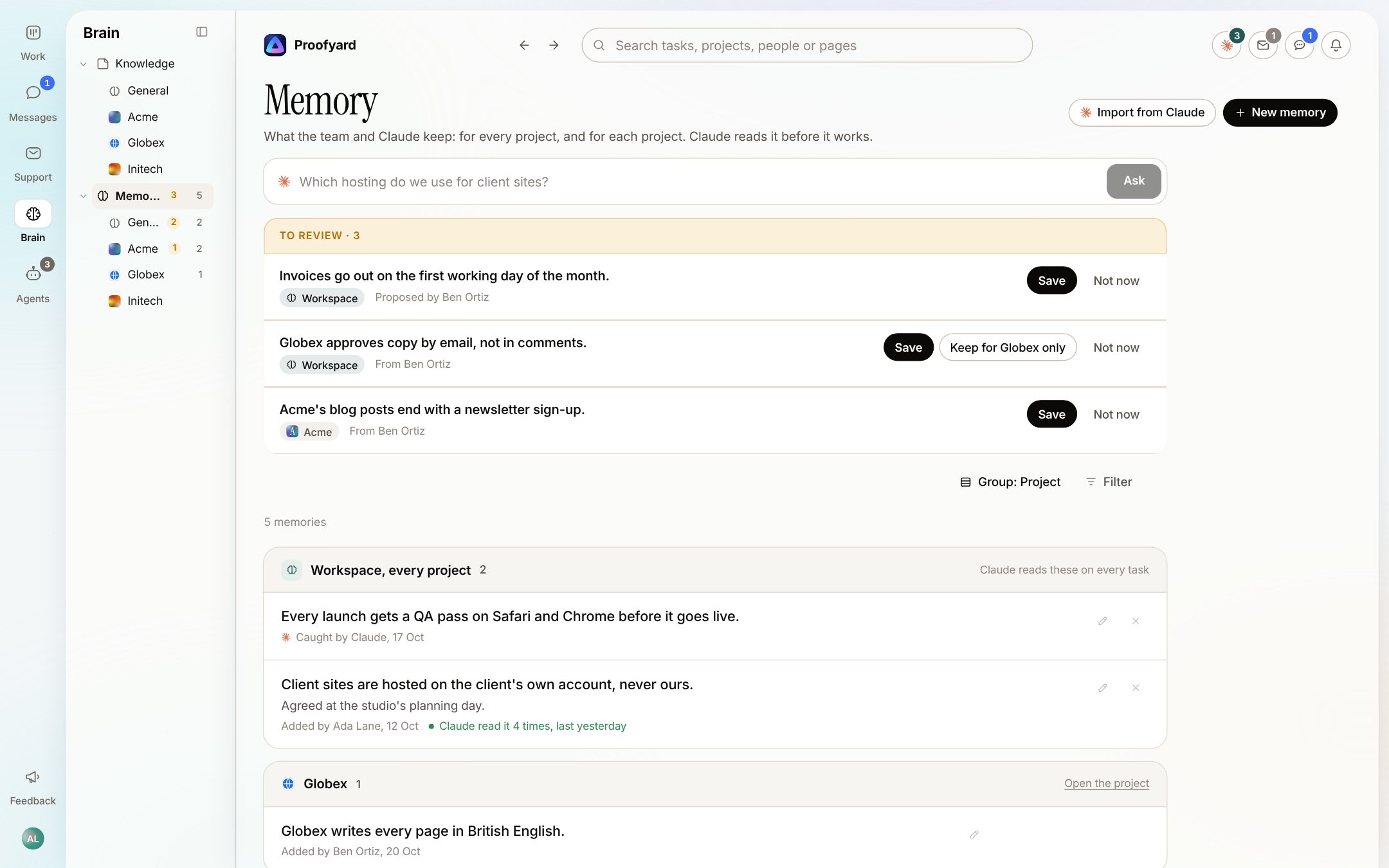
Memories are short: "Client sites are hosted on the client's own account." Each shows who added it or that Claude caught it, when, and how often Claude has read it. Workspace memories hold for every project; a project's own memory wins when they disagree. What Claude or a teammate proposes waits under To review with Save and Not now, and a member's workspace memory waits for an admin.
- 03
A Project card from the client's own site
Read the client's site and Claude reads up to 25 public pages, then drafts what they do and sell, who they sell to, how they write, and their colours and fonts. Each suggestion names the page it came from and how sure Claude is. Audiences come as personas: buying stage, what they want and worry about, the pages they look at first. You keep the details you want, edit any of them first, and Undo takes a save back.
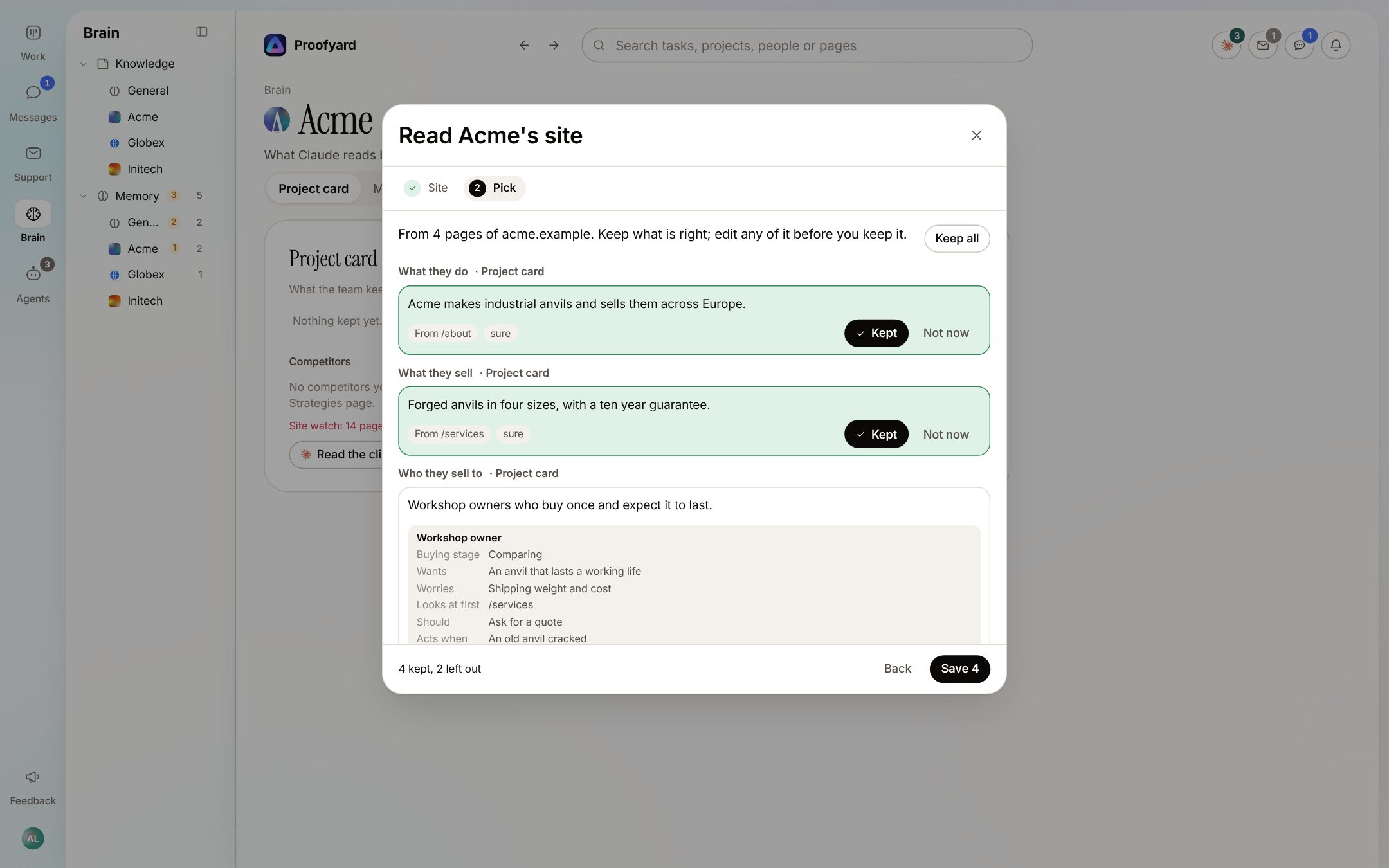
The screenshots are from the app with sample data: Acme, Maya and the team are made up.
Where agencies use it
Where the knowledge base earns its keep
Onboarding a new client
Read the client's site before the kickoff call, keep what is right on the Project card, and add the competitors they name with why each matters.
A brief that breaks an old rule
A task shows, in its side column, what the project's memory says against it, what to keep in mind and what it leaves open. Not relevant or Do it anyway, with a short note that becomes the newer memory.
Moving off another tool
Import a document turns an SOP, a brand guide or a price list into draft pages, memories and skills. Import from Claude brings in what claude.ai already remembers about your work.
Planning past the launch
Growth holds a project's goals, how you measure them, opportunities and next steps; Strategies holds SEO, content, conversion, ads, social and email. Draft with Claude fills only the empty parts, and nothing is saved until you save.
Catching decisions in comments
When Claude spots something worth keeping in a comment, it asks under that comment: Save to memory or Not now. Other suggestions wait on Claude's button at the top until someone keeps or leaves them.
Working from Claude Code or Cowork
Over MCP, read_knowledge lists and reads the pages and read_memory reads a project's memory and the workspace's. They act as the signed-in person and see only what that person can see.
What it will not do
Honest limits
Claude never keeps anything on its own. A site read, an imported document and every suggested memory wait for a person to keep them.
Only an admin approves or changes workspace memory. Anyone else can keep a memory for their own project.
Files on a Knowledge page go up to 20 MB, and Import a document takes PDF, Word (.docx), text or Markdown up to 4 MB. A site built with scripts only may give Claude nothing to read.
Folders are one level deep: they sit in General or in a project and hold pages, not other folders.
Questions
Brain
What does Claude read before it works on a project?
The studio's Knowledge pages that are switched on for Claude, the workspace memory, and that project's own pages, memory, Project card, Growth and Strategies pages. A page switched off stays visible to the team, and Claude skips it.
Can a client see the knowledge base?
No. Knowledge pages are for the team: clients and guests are not shown them, and a project's own pages are seen only by that project's team. Changing pages needs the full team.
How do I know where a memory came from?
Each memory says who added it, or that Claude caught it, with the date and where it was said: a comment, a task, a meeting, a client's mail or Slack. It also shows how often Claude has read it, and one kept over six months ago that nobody reads asks to be checked.
Can I correct what Claude found?
Yes. Edit a suggestion before you keep it, edit a kept memory in place, or remove a detail from the Project card. Each change has Undo.
Does reading a site or a document cost AI credit?
Yes, about as much as a long answer from Claude, counted in the workspace's monthly AI credits.
Who makes it
Made by Woofocus, a web studio, for its own work first
Woofocus has built and looked after client websites since 2010. We made Proofyard because our own production was spread across a task tool, a feedback tool and long chat threads, and we are moving our studio's work into it now. Any agency can open its own workspace.

Ali Demirci
Founder of Woofocus
Ali has designed, built and looked after client websites since 2010 and runs Woofocus, a small web studio. Proofyard is the board he built to run Woofocus's own production after years of carrying work between Asana, BugHerd and chat.
- 4.99/5rating on Codeable across 219 projects for 74 clientsSource: Codeable profile, October 2026
- Since 2010building and looking after client websitesSource: woofocus.com
- ~7,000tasks in our own Asana workspace, the work Proofyard was built to runSource: Woofocus Asana workspace, read 3 October 2026
“Communication was always clear and timely, making it easy to stay aligned on progress.”
“Ali delivered on time and worked tirelessly with us to make sure that we were satisfied.”
Start with three pages
Open a workspace, fill in About the studio, Services and prices and Brand voice, then read one client's site for its Project card.