 By Ali Demirci, founder of Woofocus · October 24, 2026 · 9 min read
How we checked, and what we did not
We make Proofyard, a production board for web and design studios with a website feedback tool built in. It is the last entry below and we say so there. None of the other vendors pays us or knows we wrote this.
We have used BugHerd on client sites for years. The others we have not run on a real client project, so this is a reading of their own pages on 24 October 2026, not a hands-on test. Prices are list prices before tax and change often: check the vendor's page before you buy.
Every tool gets the same four questions: what a team of five pays, how notes are captured (a script on the site, a browser extension, or the site loaded through the tool), whether clients need an account, and which project tools the notes can go to.
The short answer
- $29a month for five on Userback Team, billed yearly, the lowest here
- $99a month for five on Pastel Team, billed yearly, the highest with a yearly price shown
- $149a month on Marker.io Team, billed yearly, the plan with console logs
- 7 of 10say on their own pages that clients need no account at all
What matters most to you?
Use Userback Team or BugHerd Standard
Both hold five people for under $45 a month billed yearly, with a widget on the site.
- Setup
- A script on the site
- Claude sees
- Userback's notes over its MCP connectors; BugHerd's MCP server is in beta
Side by side
What five people pay on the cheapest plan that holds five team members. Clients and other reporters are free on all of them.
| Tool | Plan for five | A month, billed yearly | A month, billed monthly |
|---|---|---|---|
| Userback | Team, 5 seats | $29 | $39 |
| BugHerd | Standard, 5 members | $42 ($500 a year) | $50 |
| Marker.io | Starter, 3 seats and 2 extra | $47 | $71 |
| Proofyard | 5 team members | $60 | $75 |
| Markup.io | Pro, any number of users | $82.50 with 75 MarkUps a month | $79 with 50 MarkUps a month |
| ruttl | Pro, $18 a user | Not shown on the page | $90 |
| Atarim | Pro, up to 100 seats | 20% off, price not shown | $67 |
| Feedbucket | Business, 25 members (Pro holds 2) | 20% off, price not shown | $89 |
| Pastel | Team, 5 users | $99 ($1,190 a year) | $119 |
| Usersnap | Growth, any number of seats (Starter holds 2) | Up to 3 months off, price not shown | €129 |
How the notes are captured, and what the client has to do:
| Tool | Capture | Client account |
|---|---|---|
| BugHerd | A script on the site, or a browser extension | None; a name and email on the first note, and a guest account is made for them |
| Marker.io | A widget on the site, or a browser extension | None |
| Markup.io | Paste a URL, or its Chrome extension | None; guests never sign up |
| Pastel | Paste a URL; the site is shown through Pastel's proxy | None |
| Atarim | A WordPress plugin, a Chrome extension, or a URL loaded in Atarim | None; a name and email on the first note |
| Feedbucket | One line of JavaScript, or a plugin for some platforms | None |
| Userback | A widget on the site, or a browser extension | Reporters take no seat |
| Usersnap | A widget snippet, or a browser extension | End users take no seat |
| ruttl | Paste the site's URL | None; a shareable link |
| Proofyard | One script tag or a Google Tag Manager tag | None; a review link |
The tools, one by one
BugHerd
The tool this list is measured against. Add BugHerd's script to the site, or use its browser extension; a client who opens a site without the script is asked to install the extension. Clients do not log in: they give a name and email on their first note, and BugHerd makes a guest account for them in the background. Standard is $42 a month billed yearly ($500 a year, $50 monthly) for five members, Studio $67 for ten and Premium $125 for 25. There is no free plan.
The catch: Jira, Asana, ClickUp, Monday, Linear and Teamwork come with Premium, $1,500 a year. On Standard you get Trello, Slack, Teams, GitHub and Zapier. Our longer BugHerd comparison covers where BugHerd is still the better choice.
Marker.io
Marker.io puts a widget on the site and also has a browser extension. Guests and reporters send feedback without an account. Starter is $39 a month billed yearly ($59 monthly) with three seats, and extra seats are $4 a month billed yearly ($6 monthly). Starter sends notes to Trello, Asana, ClickUp, GitHub, GitLab, Linear and Notion; Jira starts on Team. There is also an Agency plan at $99 a month billed yearly with 15 seats, for agencies that qualify.
The catch: console logs, network requests and session replay are on Team, $149 a month billed yearly. On Starter a bug report has the screenshot and the browser, not what broke.
Markup.io
MarkUp opens a live site from a link you paste, and has a Chrome extension. Guests comment without signing up. It is priced by MarkUps a month, not by people: Pro is $79 a month for 50 MarkUps, $99 for 75 and $129 for 100, with any number of users. Yearly, 75 MarkUps cost $990 a year. Extra MarkUps are $4 each, sold in tens.
The catch: its pricing and home pages name no project tool to send notes to, only its Chrome extension. If notes have to reach Jira or Asana, check with them first.
Pastel
Pastel shows the client's site through its own proxy, so nothing is installed on the site. Anyone can comment or view without an account. Pro is $29 a month billed yearly ($350 a year, $35 monthly) for two users and three active canvases. Team is $99 billed yearly ($1,190 a year, $119 monthly) for five users, $24 for each more, with no limit on canvases.
The catch: integrations (Trello, Asana, Jira, ClickUp, Monday, Zapier) are on Team only. A proxied site can also behave differently from the real one, which matters most when the bug is in a script.
Atarim
Atarim has three ways in: its WordPress plugin, a Chrome extension for your team, or a page URL that Atarim fetches and shows. Clients need no account; they give a name and email on their first note, and the browser remembers them for 90 days. The free plan covers one site. Pro is $67 a month for up to 100 seats and 5,000 credits a month, and billing yearly saves 20%.
The catch: you buy credits, not seats, and the pricing page itself gives two figures for how many credits a client uses in a month. Pages behind a login or a staging password do not load in the fetched view, and Atarim's own help says script-heavy pages may not render perfectly there.
Feedbucket
One line of JavaScript on the site, or a plugin for some platforms; clients use the widget without an account. Pro is $49 a month for two team members and Business $89 for 25, with 20% off billed yearly. Every plan connects to Asana, Jira, ClickUp, Trello, Basecamp, Monday, Slack, GitHub, Linear, Teamwork, Notion and Zapier, which is the widest list here at the entry price. It also has an MCP connector on Pro.
The catch: console logs and CSV export are on Business only, so a team of three pays $89, not $49, to see what broke.
Userback
Userback has a widget and a browser extension. Reporters do not take a seat. Free Forever gives two seats and two sites; Team is $29 a month billed yearly ($39 monthly) with five seats and five sites, the cheapest plan for five on this list. Team adds two-way sync with Jira and ClickUp, Zapier and MCP connectors.
The catch: on the free plan feedback stays available for seven days. Userback is also built for product teams (session replay, a feature portal sold on top), so part of what you pay for may not fit client work.
Usersnap
Usersnap installs a widget with one code snippet and has a browser extension. End users do not need a seat. It is priced in euros: Starter is €49 a month for two seats and two projects, Growth €129 with no limit on seats and ten projects. Slack, Jira, Asana, Linear and over 50 more are on every plan, with two-way sync for Jira, Asana, Linear and Azure DevOps.
The catch: plans are counted in projects, page views and surveys. It is made for software companies asking their users for feedback, more than for an agency showing a client a staging site.
ruttl
Paste the site's URL when you make a project and send the client a shareable link; ruttl's own page says clients leave feedback "without needing any sign-ups". Basic is free; Pro is $18 a user a month, $90 for five. Basic connects to Slack, Trello, Asana and Jira, and Pro adds ClickUp. It also reviews PDFs, images and mobile apps.
The catch: its pricing page does not agree with itself on the free plan (up to five users on the plan card, one in the table), and the pages we read do not say how the site is loaded or show a yearly price.
Proofyard (ours)
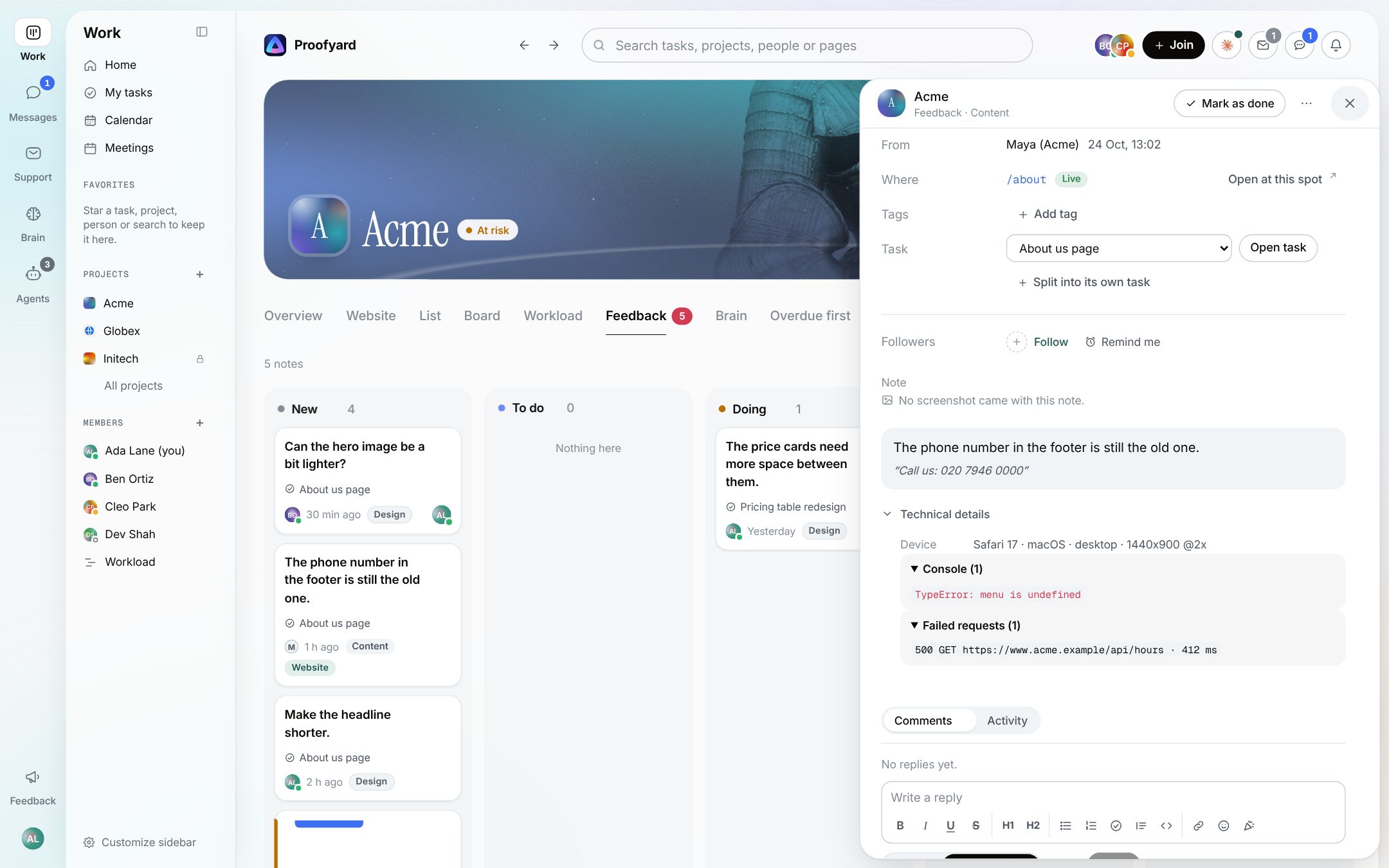
Proofyard is a production board for web and design studios, and website feedback is one part of it. Add one script tag or a Google Tag Manager tag; the client opens a review link, with no account and no extension, for 14 days or up to 90. Each note comes with the page, the element and its text, a screenshot with password and card fields greyed out before it is uploaded, the browser and screen size, and the console errors and failed requests. Notes land on the project's Feedback board next to the tasks, the Claude Design boards and the client, and can go to Claude Code over our connector. When a note is fixed, the client is asked to check it: Looks good or Still wrong. It costs $12 a team member a month billed yearly ($15 monthly), and clients are free.
The catch: no video or audio notes, no proofing of PDFs or images, no sync with Jira or Asana, and no free plan, only a 14-day trial. It is also a whole project board, priced per person: if your projects live in Jira and you only want feedback, one of the tools above costs less. The website feedback tool page shows each step, and design approval covers the sign-off after the fixes. What it costs per person is on our pricing page.
How to choose
Start with where the notes have to end up. If your developers live in Jira, the integration decides it, and the plan that includes it is the real price: BugHerd's Premium, Marker.io's Team, Pastel's Team. If the notes stay with the agency, the cheapest seat that captures console errors is the next question.
Then look at the client. A script on the site is the least work for them and sees the page as it really is. A pasted URL or a proxy needs nothing on the site, which helps when you cannot touch the client's code, but pages behind a login and pages full of scripts are where it struggles. An extension is fine for your team and a hurdle for most clients.
Tick what the tool you are weighing does
0 of 7
Start with where the notes have to end up and what the client has to install. Those decide the rest.
Sources
All read on 24 October 2026, except where a date is given. Prices are list prices before tax.
- BugHerd: pricing, feedback from clients, installing with JavaScript
- Marker.io: pricing
- Markup.io: pricing, home page
- Pastel: plans
- Atarim: pricing, collaborating with clients by URL, guest mode
- Feedbucket: pricing
- Userback: pricing, integrations
- Usersnap: pricing
- ruttl: pricing, comment on live websites
- Proofyard: the app as built on 24 October 2026; the screenshot uses sample data.