 By Ali Demirci, founder of Woofocus · November 4, 2026 · 12 min read
The short answer
If you need a real help desk, with a knowledge base, live chat, response-time targets and reports, Help Scout is still a sound choice: Standard is $25 a user a month billed yearly, so five people pay $125 a month. Zendesk and Freshdesk are the other help desks to price against it.
If your team lives in email and needs shared inboxes with assignments and notes, look at Front, Missive or Hiver, which works inside Gmail. If money is the main question, a Google Groups collaborative inbox comes with Google Workspace from $7 a user, and Teamwork Desk starts at $9.50.
If the real trouble is that client mail never reaches the task it is about, a help desk will not fix that on its own. Then you want an inbox inside your project tool: Teamwork Desk next to Teamwork.com, or ours.
What our own shared inbox showed us in nine days
We make Proofyard, a production board for web and design studios, and its Support inbox has handled our own studio's client mail since late October. We counted what happened to the conversations that reached it between 27 October and 4 November 2026. What follows are counts and what we noticed, with no clients' names, subjects or words.
- 180+conversations reached our studio's shared inbox in nine days
- 131were closed with nobody handling them and no task made
- 28+ended up linked to a task on our board
Four things we would tell any agency choosing a shared inbox:
- Most mail is not client work. 131 conversations were closed with nobody handling them and no task made: hosting alerts, receipts, newsletters and cold pitches among them. The first job of a shared inbox is to put that away, by sender, without losing the one client mail in between. Look for rules by sender and a place for unknown senders that is not the main list.
- The client mail that matters is about work already on the board. At least 28 conversations ended up linked to a task. Each of those would otherwise have been copied, forwarded or retold to whoever had the task.
- Clients write to a person, not to an address. Several mails to our shared address opened with one of our names. An inbox has to show those to that person without taking them away from the team.
- What you write inside the team leaks into mail. In our first days a mail started from a task took the task's title as its subject line, and our titles are written in Turkish for the team. The client got a Turkish subject, and we wrote back to explain. Check the subject before you press Send.
What Help Scout does well, and what it costs
From Help Scout's own pricing page and docs, read on 4 November 2026:
- Prices per user. Standard is $25 a user a month billed yearly ($30 monthly), Plus $45 ($54) and Pro $75 ($90), with Pro at a minimum of 10 users.
- A free plan with a ceiling. Free covers up to 5 users, 1 inbox and 100 contacts a month, where a contact is "Someone who received a reply from your team or had their question resolved by the AI assistant". At the limit, its docs say, "you won't be able to reply to customers", and mail sent from Free is "branded with Sent with Help Scout".
- Inboxes. Standard includes 2, Plus 5 and Pro 10; each extra inbox is "$10 per month when paid annually (or $12 per month)".
- The help desk parts. Live chat, a knowledge base (Docs), one basic SLA policy, workflows, unlimited saved replies and reports from Standard. Collision detection, which warns you when a teammate is answering the same mail, is "included with all plans and is automatic".
- AI. An AI inbox assistant on Standard, AI Drafts and summaries from Plus, and an AI agent that answers customers at "$0.75 per resolution".
- Where your data is. Help Scout says it is "hosted on AWS servers in the United States" and "SOC 2 compliant". We found no EU hosting option.
Its pricing has moved. In April 2025 a Help Scout customer, Daniel Jalkut, wrote on his blog that existing accounts were being moved to plans priced by the customers helped each month. On 4 November 2026 the pricing page charges per user again, while Help Scout's docs still describe "contact-based billing accounts" next to user-based ones. If you are on Help Scout now, check which kind of billing your account is on before you compare.
Where Help Scout fits an agency less well
Help Scout is built for a support team answering many customers. A studio's client mail is smaller and more tangled with the work:
- The mail and the task live in different tools. Help Scout's apps page lists Asana, Jira, Linear, Trello and Slack, and its pricing puts Jira and Linear on Plus. Someone still has to link each conversation to the right task, and the person doing the task reads the client's words in another tab.
- An inbox per client costs extra. If each client gets its own address, Standard's two inboxes run out at the third client.
- You pay for help desk parts a studio rarely uses. Docs sites, Beacon chat widgets, SLA policies and workflows matter to a product's support team. A five-person studio with fifteen clients mostly needs to know who answers, and where the work is.
None of that makes Help Scout a bad choice. It means the question is what job your client mail does.
Help Scout alternatives, priced for five people
The cheapest plan a five-person studio would realistically use for client mail, read on each vendor's own pricing page on 4 November 2026. US dollars, per user a month, billed yearly first and monthly second where the page shows both.
| Tool and plan | Per user, yearly / monthly | Five people a month, billed yearly | Free plan or trial |
|---|---|---|---|
| Help Scout Standard, for reference | $25 / $30 | $125 | Free plan with 100 contacts a month; 15-day trial |
| Front Starter | $25 / $35 | $125 | 14-day trial |
| Missive Starter, or Productive for rules, integrations and AI | $14 / $18, Productive $24 / $30 | $70, Productive $120 | 30-day trial |
| Hiver Growth, inside Gmail | $25 / $35 | $125 | 7-day trial |
| Google Workspace Business Starter, with a Groups collaborative inbox | $7 / $8.40 | $35 | 14-day trial |
| Zendesk Support Team | $19 / $25 | $95 | 14-day trial |
| Freshdesk Growth | $19 / $23 | $95 | 14-day trial |
| Teamwork Desk Starter | $9.50, the page shows yearly only | $47.50 | 30-day trial |
| HubSpot Service Hub Starter | $7 / $10 for new customers, list $20 | $35 | Free for up to 2 users |
| Helply, formerly Groove | No per-user fee: $42 / $49 a month for 500 credits | $42 | 14-day trial |
| Proofyard (ours) | $12 / $15 | $60 | 2 months free |
What that cheapest plan includes, and what the AI costs on top:
| Tool | Inboxes and seats | The AI, and what it costs |
|---|---|---|
| Help Scout | 2 inboxes, then $10 each | Assistant included; AI agent $0.75 a resolution |
| Front | One channel type, up to 10 seats | Copilot $20 a seat; Autopilot from $0.05 a conversation |
| Missive | Team inboxes; Starter up to 5 users | On Productive: the model provider's price plus 25% |
| Hiver | 2 shared inboxes; at least 2 seats | AI agents and Copilot listed, with no price on the page |
| Google Groups | One per Google Group | Not covered here |
| Zendesk | "unlimited email addresses" | AI resolutions past the included ones $1.50 to $2.00 each |
| Freshdesk | Not stated | AI Agent: 500 sessions once, then $49 per 100 |
| Teamwork Desk | Up to 10 agents | Dotty add-on, $69 a month |
| HubSpot | Not stated | AI Customer Agent from Professional |
| Helply | Not stated | Paid in credits |
| Proofyard | One workspace inbox, plus each person's own mailbox | Claude's credits are in the seat price |
Several pricing pages advertise a saving that does not match their own numbers, so we worked every yearly price out from the page rather than from its badge. HubSpot's Starter price is marked "Discounts available for new customers only", with no end date. Ours is a whole production board, not only an inbox, which matters when you compare $60 with $125.
Which kind of inbox fits
| What job does your client mail do? | Look at |
|---|---|
| Support for many customers, with a knowledge base, chat and targets | Help Scout, Zendesk or Freshdesk Built for support teams: SLAs, reports, Docs and AI that answers customers. Five people, billed yearly: $95 to $125 a month Watch for: AI priced per resolution on top |
| Shared email with assignments and notes | Front or Missive Shared inboxes that still feel like email, with comments inside a conversation. Five people, billed yearly: $70 to $125 a month Watch for: Rules and integrations on the plan above the cheapest |
| Staying in Gmail | Hiver, or a Google Groups collaborative inbox No new app: Hiver adds shared inboxes to Gmail; Groups comes with Workspace. Five people, billed yearly: $35 to $125 a month Watch for: Groups has no notes or reports |
| Client mail that belongs to project tasks | Teamwork Desk with Teamwork.com, or ours The mail lands next to the project, so the task gets the client's words. Five people, billed yearly: $47.50 to $60 a month Watch for: Fewer help desk parts: no SLAs or chat in ours |
The alternatives, one by one
Front
Good at: shared email that feels like email. Starter has assignments, "Internal comments and shared drafts", message templates, round robin and up to 10 rules, and Front's help centre describes "real-time collision detection".
Price: $25 a seat a month billed yearly, $35 monthly, "up to 10 seats". Copilot is "$20 / seat / month" on top, and Autopilot starts at "$0.05 /conversation".
The catch: Starter is limited to one channel type: "Email, chat (Resolve), or SMS". SLAs start on Professional.
For agencies: every plan lists project tools such as Jira, Asana, Monday and ClickUp, and Front's security page says "We support data hosting options in the U.S. or the EU".
Missive
Good at: a small team's shared mail at a low price. Starter has team inboxes, assignment, internal threads, collaborative drafts and canned responses, for up to 5 users.
Price: $14 a user a month billed yearly, $18 monthly. Productive, $24 ($30), adds up to 1,000 rules, integrations such as Asana, ClickUp and Trello, analytics, an API and MCP.
AI: "AI requires the Productive or Business plan"; after a small free credit it is billed at "Provider price + 25% markup", or you bring your own key.
The catch: the rules and integrations an agency needs are on Productive, so plan on $24.
Hiver
Good at: staying in Gmail. Growth adds shared inboxes, collision detection, notes, shared drafts, templates, round robin and basic reports to the Gmail your team already uses.
Price: $25 a user a month billed yearly, $35 monthly, with 2 shared inboxes. "All Hiver plans start at 2 seats", then 5, then steps of 5.
The catch: SLAs are on Pro, and the pricing page lists AI agents without a price. Hiver says its data is hosted in the USA.
Gmail with a collaborative inbox
Good at: costing almost nothing if you already pay for Google Workspace. A Google Group set up as a collaborative inbox lets members "Take a conversation", "Assign responsibility" to another member, and mark it "complete, duplicate, or no action needed".
Price: included with Workspace, from Business Starter at $7 a user a month with a yearly commitment, or $8.40 on the flexible plan. Your domain has to be verified.
The catch: the work happens in Google Groups, not in Gmail, and Google's pages describe no notes, collision warnings or reports. It is a good start for two or three people.
Zendesk
Good at: a full help desk that grows. Support Team has email "with unlimited addresses", macros, triggers and automations, and prebuilt dashboards.
Price: $19 an agent a month billed yearly, $25 monthly. AI resolutions past the included ones cost $1.50 each committed or $2.00 pay as you go.
The catch: Zendesk's own help centre says "Agent collision is not available on Team plans", and SLAs, a help centre and live chat are on higher plans.
Freshdesk
Good at: a help desk with a customer portal and knowledge base on its first paid plan. Growth has the shared inbox, threads, automations and analytics.
Price: $19 an agent a month billed yearly, $23 monthly. The AI Agent comes with 500 sessions once, then "$49/100 sessions".
The catch: more than one SLA policy starts on Pro, and Copilot too.
Teamwork Desk
Good at: client mail next to client projects, if you run Teamwork.com. Starter has collision detection, private notes, canned responses, help docs, a customer portal and basic reports, for up to 10 agents.
Price: $9.50 an agent a month billed yearly, the lowest per-user price here. The Dotty AI add-on is $69 a month for 1,000 tickets analysed and 100 AI-drafted replies.
The catch: triggers and live chat start on Pro and SLAs on Premium. Teamwork offers EU hosting "from our data centers in Dublin, Ireland". Our Teamwork.com comparison covers the project side.
HubSpot Service Hub
Good at: support in the same place as your CRM. Starter has ticketing, live chat and snippets, and HubSpot is free for up to 2 users.
Price: $7 a seat a month billed yearly or $10 monthly for new customers, against a list price of $20. The AI Customer Agent, SLAs and a knowledge base start on Professional, at $90 a seat billed yearly plus "$1,500" onboarding.
The catch: the discount has no stated end, so price the list rate too.
Helply, formerly Groove
Groove's pricing page now sends you to Helply, whose About page says "Groove is now Helply". It charges "No per-user fees": 500 credits are $49 a month, or $42 billed yearly. Its pricing page does not describe the shared inbox in detail, so try it before you count on it.
Our Support inbox
This is Proofyard's Support inbox, which we built for the mail described above. From our own code on 4 November 2026:
- Mail finds its project. Your support address forwards to an address Proofyard gives the workspace; mail goes to a project by its domains or addresses. Mail from senders no rule knows waits in Unfiled, outside the main list, and "Remember my choice" makes a rule for the sender's next mail.
- Claude reads it, a person decides. On each mail Claude writes a short summary and suggests the open tasks it is about, or drafts a new task. Nothing is linked or created until someone ticks it, and Claude never sends a mail.
- Whose turn it is. Open is split into Needs reply and Waiting on them, and mail already on a task is listed apart. Each mail can be assigned to one person, with a note they get in their Inbox. When a client's latest mail has you in To or names you, it shows in your Open as To you, even when a teammate handles it; Done for now puts a mail aside until the client writes again.
- The team side. Team notes, saved replies, a signature, and mail about money kept private to admins. Every send waits 5 seconds with Undo.
- Where replies come from. Proofyard's sending address with Reply-To set to your inbox, or your own Gmail once you connect it.
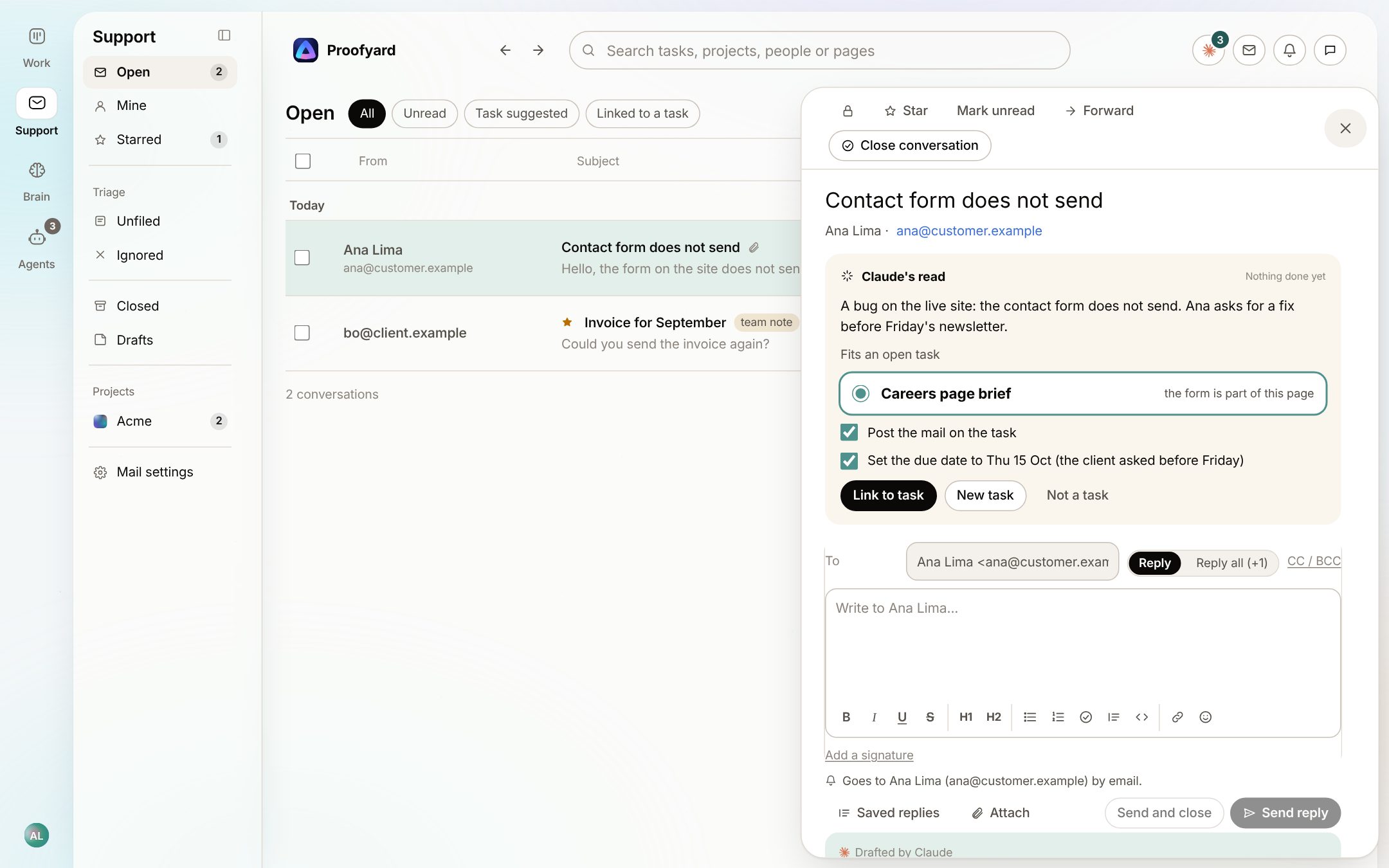
What it does not do, as of 4 November 2026: no knowledge base, no live chat, no SLA targets or reports, and no warning when two people answer the same mail at once. Sending from your own domain works only through Gmail. If you need those, a help desk is the better tool: Help Scout's Standard plan alone has live chat, a knowledge base, an SLA policy, reports and collision detection.
Support is in the seat price, $12 a team member a month billed yearly, with clients free; the details are on our pricing page. The client side of the same board, where clients approve and see what waits for them, is in our guide to a client portal for agencies, and the rule that Claude prepares and a person sends is the one in our guide to what an AI agent should ask before it acts.
What to check before you switch
Tick what the inbox you are weighing does for your agency
0 of 8
Start with how mail gets sorted; the rest only helps once that works.
Run the new inbox next to the old one for two weeks with one client before moving everything. Count what you did not have to forward or retell.
Sources
Every page read on 4 November 2026, the pricing pages in a browser with both billing toggles.
- Help Scout: pricing, free plan, collision detection, AI resolutions, billing and plans, security, integrations; Daniel Jalkut, Whither Help Scout?, 30 April 2025, on the move to contact-based plans.
- Front: pricing, collision detection, security.
- Missive: pricing, AI.
- Hiver: Hiver in Gmail pricing, security.
- Google: collaborative inbox, take and assign conversations, Business editions and prices.
- Zendesk: pricing, avoiding agent collision.
- Freshdesk: pricing.
- Teamwork Desk: pricing, EU hosting.
- HubSpot: Service Hub pricing.
- Helply, formerly Groove: pricing, about.
- Proofyard: our Support inbox and pricing on 4 November 2026; our own counts from our studio's inbox, 27 October to 4 November 2026; the screenshot is sample data from our preview.